OrgX00
Case 01 / flagshipFounder-built · active platform

OrgX

The prompt ends. The company keeps moving.

OrgX lets a person manage a fleet of agents from the AI client they already use—without losing the goal, the decisions, the quality bar, or the proof when work changes hands. It is the shared operating context beneath the clients, not another chat destination.

Jobcarry work across agents
Ownershipfounder · product · architecture
Boundaryhuman consequence
Deliveryweb · MCP · plugins · widgets
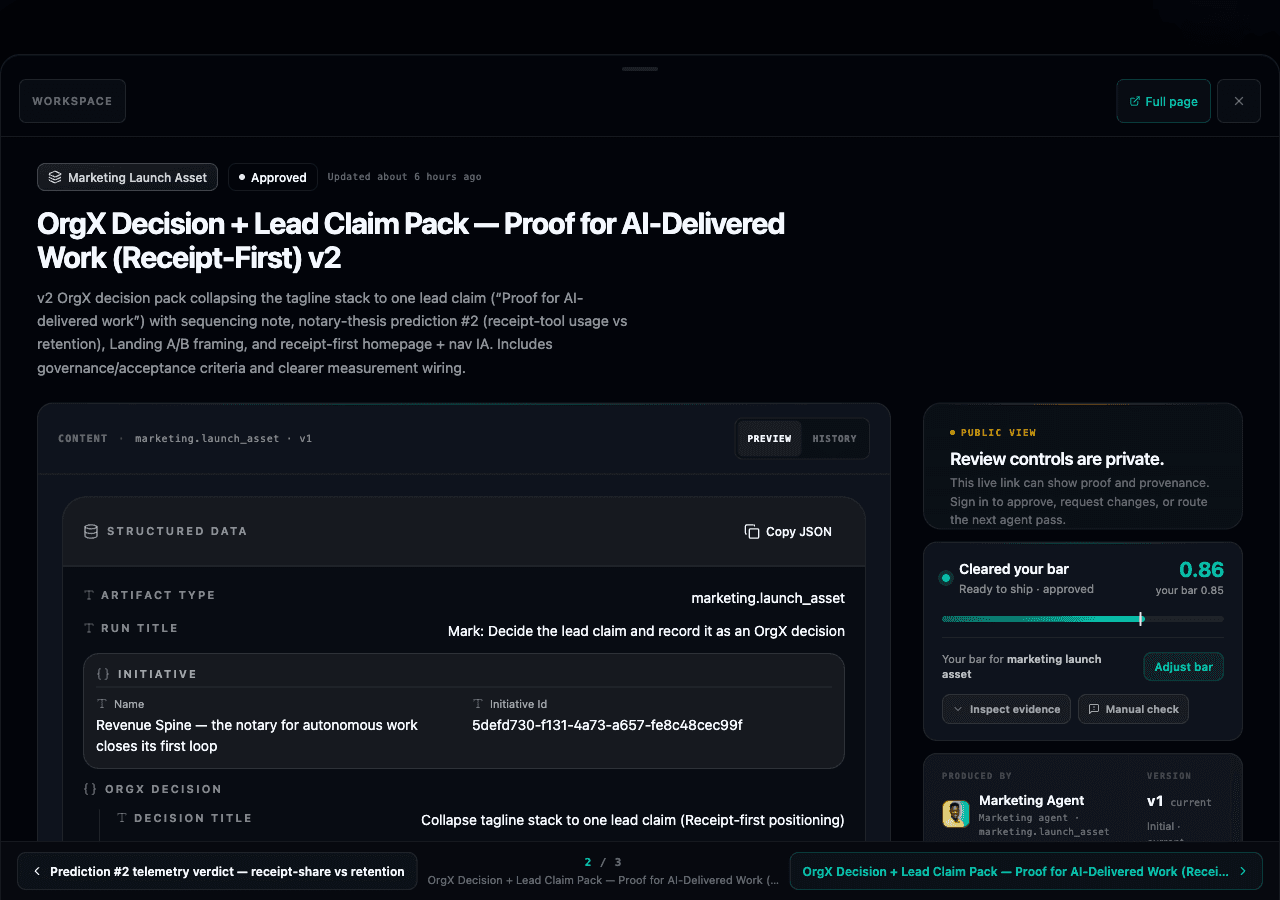
OrgX artifact viewer showing a lead claim pack, decision provenance, and evidence score
The artifact is the receipt

Output, provenance, quality, and review state are inspected together—not reconstructed after the fact.

01

The consequential problem

The failure was fragmentation, not intelligence

Agents could do more work than a person could reliably follow.

The model could draft, research, code, and coordinate. But the work scattered across prompts, clients, repositories, and human memory. A handoff between Claude and Codex could erase the goal, the decision that shaped it, and the evidence already gathered.

More autonomy made the gap more dangerous. Activity increased while the founder or team lead had less confidence about what moved, why it moved, and what deserved attention.

  • Context vanished at client and repository boundaries.
  • Output was separated from decisions, constraints, and evidence.
  • Human review scaled with activity instead of consequence.
02

What I saw

The prompt was the wrong primitive

The organization—not the conversation—had to remember why the work exists.

The next agent needs more than a summary. It needs the goal, definition of done, decisions and why, available tools, missing permissions, budget, confidence, and the next useful action. Those become a compiled handoff instead of a transcript dump.

That reframed OrgX from an orchestration destination into infrastructure that can meet the operator where the work already happens.

03

The decision that changed the system

The architecture followed the product thesis

Carry one work graph across clients, then make consequence—not activity—control the system.

The work graph connects goals, initiatives, agents, decisions, artifacts, receipts, cost, and value. The owner's quality bar decides what returns for review. Tool policy pauses publishing, payments, messages, merges, and other external effects at the human boundary. Recovery can retry, narrow scope, ask a specialist, checkpoint, or stop.

01Shared context

Intent, constraints, decisions, and prior evidence enter together.

02Client execution

Specialists act in the interface best suited to the work.

03Trust boundary

Consequence determines when human judgment must enter.

04Proof returns

The artifact, provenance, and quality outcome become memory.

04

System anatomy / rationale / surfaces

A platform, protocol surface, and proof system

Five mechanisms turn a fleet of agents into accountable company movement.

The difficult part is preserving the cause chain: why the work exists, what the agent knew, which tools it could use, where a person had to decide, what the result proved, and whether the next move is still worth its cost.

Decision anatomy / select a knot

Pressure did not decorate the architecture. It determined it.

Before / tension

A new agent receives a task title and reconstructs the company from scattered chats, docs, and repo state.

The knot / decision

Compile the goal, definition of done, decisions and why, proof, permissions, confidence, and next action into one context pack.

After / consequence

The next client can continue the work without pretending a transcript is organizational memory.

buildAgentContextPack · compileGoalFrame · private core
01 / client edgeMeet the operator where work already happens

Claude, ChatGPT, Codex, Cursor, VS Code, Windsurf, Zed, OpenClaw, and other MCP-capable clients enter the same organizational context without being flattened into one UI.

MCP clients · native plugins · web app
02 / transport + identityAuthenticate the person; isolate the session

Streamable HTTP and SSE coexist behind OAuth 2.1, PKCE, and dynamic client registration. Each MCP session is isolated in a Durable Object rather than trusted as a stateless chat request.

Cloudflare Workers · OAuth Provider · Durable Objects · SQLite
03 / tool grammarConstrain capability into legible verbs

A canonical tool grammar moves from bootstrap and search through plan, spawn, decide, write, attach, act, and submit receipt. Zod contracts keep calls structured and interoperable.

Model Context Protocol · Zod · structured results
04 / work graphRemember the organization, not only the user

Initiatives, workstreams, milestones, tasks, agents, decisions, approvals, artifacts, and outcomes retain the relationships a new session needs in order to continue responsibly.

Next.js · TypeScript · Supabase · React Query
05 / execution planeLet specialists act without hiding the boundary

Agent runtimes, queues, sandboxes, and durable workflows execute the work. Trust ladders and consequence-aware gates determine when an operator must enter.

OpenAI Agents SDK · Anthropic Agent SDK · Inngest · E2B · Trigger.dev
06 / proof returnMake the outcome independently inspectable

Artifacts return with versions, provenance, evaluation, review state, and a receipt. Proof rooms and embedded widgets make that state legible beyond the dashboard that created it.

MCP Apps · artifact renderers · evaluators · proof rooms
Architecture rationale / pressure → choice → consequence
PressureDecisionWhy it mattered
The task outlives the chatUse an organizational work graph as the durable primitive

The next agent can resume from decisions, owners, artifacts, approvals, and proof instead of reconstructing a transcript.

Many clients, one operating contextSeparate the continuity contract from each client surface

Clients keep their native strengths while organizational state remains portable and accountable.

Autonomy increases review volumeEscalate by consequence and return receipts

Human attention is reserved for irreversible or ambiguous boundaries—not every unit of agent activity.

Proof must travelReturn structured results plus embedded MCP Apps

A reviewer can inspect the artifact, status, provenance, and next action inside the client where the work arrived.

Surface atlas

The architecture is only complete when every operator and client boundary has a legible surface.

01 / operator

Agent desk + chat timeline

Focus, delegation, approvals, tool calls, and outcomes stay attached to the agent's current work.

02 / runtime

Live room + processing inspector

Active execution, handoffs, blocked decisions, and run state become legible without pretending raw telemetry is judgment.

03 / proof

Artifact viewer

Code, design, video, data, diffs, marketing work, receipts, and pull requests render on their own terms.

04 / governance

Quality + trust controls

Versioned quality bars remain separate from observed signals; autonomy is bounded by consequence.

05 / external

Proof rooms

Selected outcomes become durable, shareable capsules instead of screenshots without provenance.

06 / embedded

MCP widget system

Initiative pulse, morning brief, decisions, search, status, and task surfaces bring the work graph into AI clients.

07 / integration

Client + host plugins

OpenClaw and other client bridges inherit host strengths while adding shared organizational memory.

08 / quality

Benchmark + evaluation

Judged criteria, receipts, and publication artifacts turn quality claims into a repeatable evidence system.

Product + interface

Next.js App Router · React · TypeScript · React Query · Xyflow

Data + identity

Supabase · PostgreSQL · Clerk · OAuth 2.1 · PKCE

Agent + workflow

OpenAI Agents SDK · Anthropic Agent SDK · Inngest · E2B · Trigger.dev

Protocol + edge

Model Context Protocol · MCP Apps · Cloudflare Workers · Durable Objects · Zod

Reliability + business

Sentry · PostHog · OpenTelemetry · Upstash · Stripe

Technology atlas / select a mark

The tools are evidence only when the choice is legible.

A curated record of where each system earned its place—not a wallpaper of configured integrations.

Embedded surfaces / real product evidence

These are working MCP and operator surfaces, not concept renders.

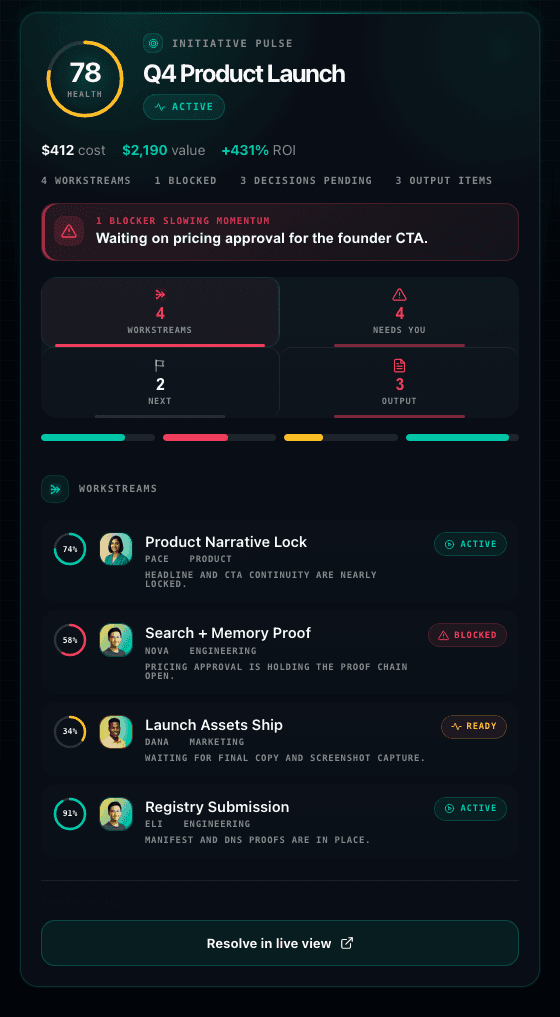
OrgX initiative pulse MCP widget showing health, blockers, workstreams, decisions, and outputs
Initiative pulse

Organizational health, the blocking boundary, workstream progress, and a live continuation action in one embedded surface.

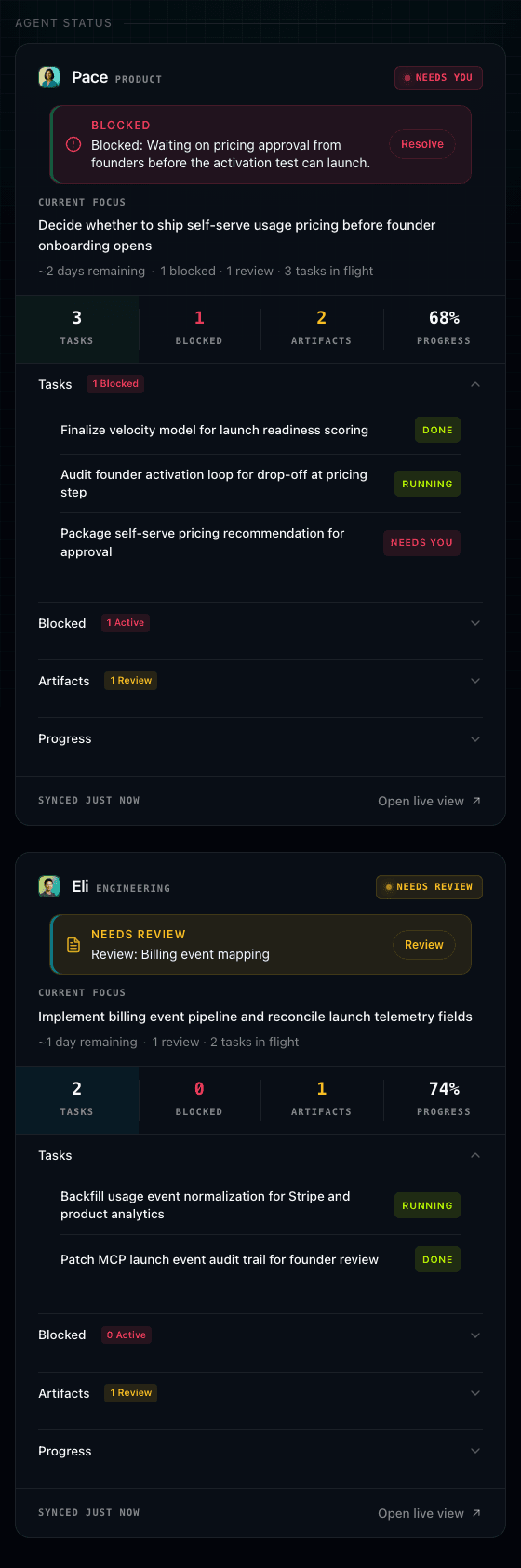
OrgX agent status MCP widget showing focus, blockers, tasks, artifacts, and progress
Agent status

The widget distinguishes current focus, blocked work, review, artifacts, and progress instead of compressing everything into online or offline.

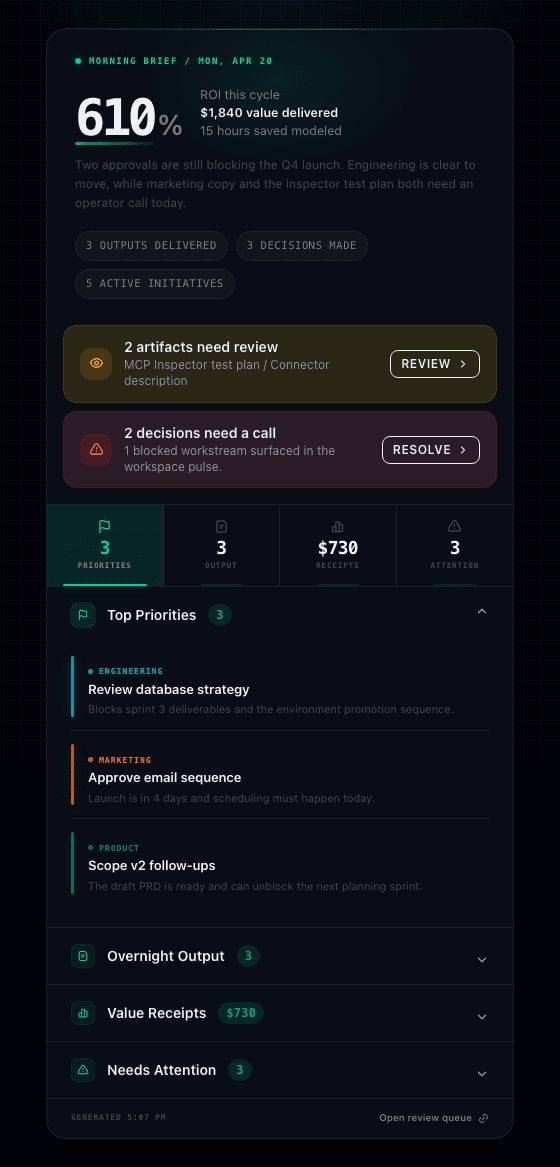
OrgX morning brief MCP widget summarizing priorities, decisions, and work requiring attention
Morning brief

The next session begins with grounded organizational state and explicit judgment requests—not a blank prompt.

OrgX decisions MCP widget with pending decisions and decision history
Decision surface

The information needed to decide, the consequence, and the approval action stay together inside the client.

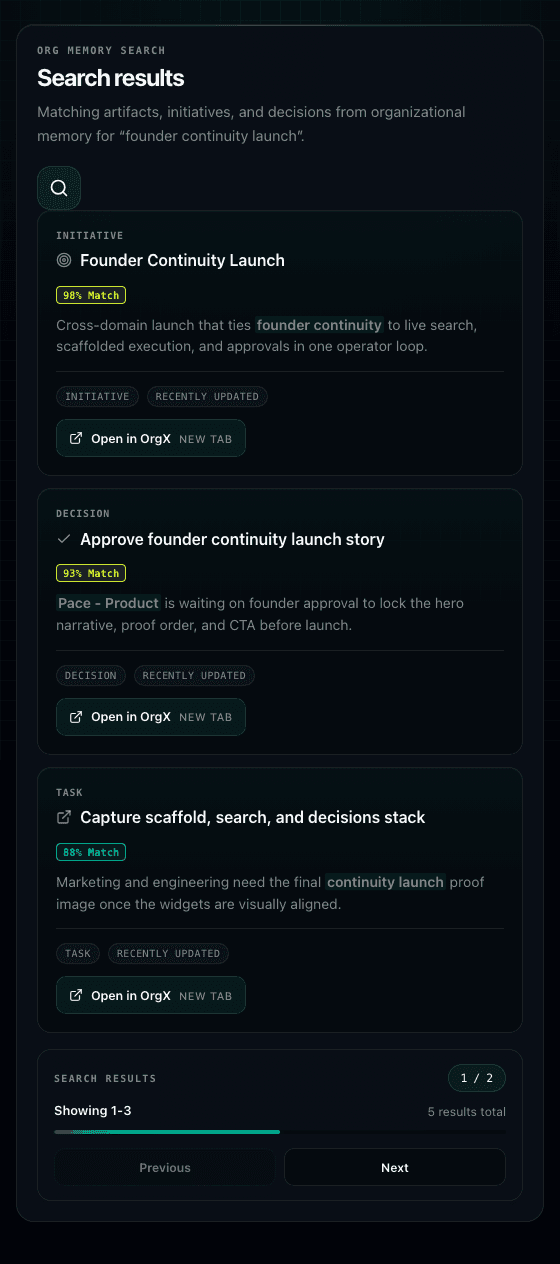
OrgX search MCP widget returning organizational memory across artifacts and decisions
Memory search

A new session can recover the relevant decision and artifact without reading the entire organizational transcript.

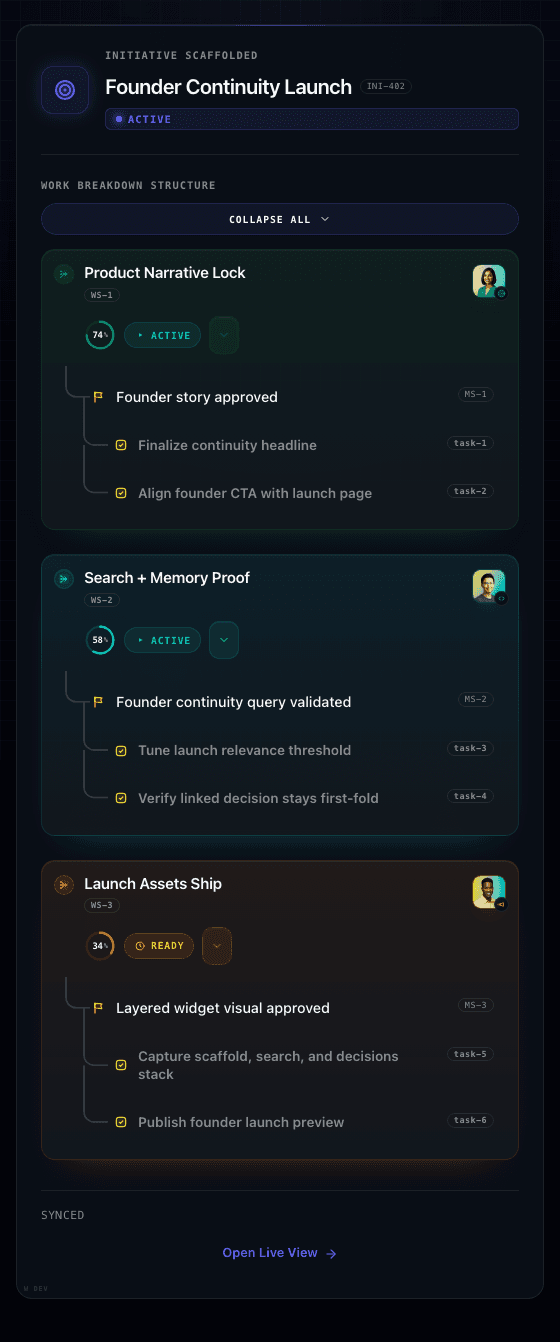
OrgX scaffolded initiative MCP widget with workstreams, owners, and next actions
Plan becomes work

The output is not a paragraph called a plan; it is an inspectable structure with owners, boundaries, and a next action.

05

Authentic proof

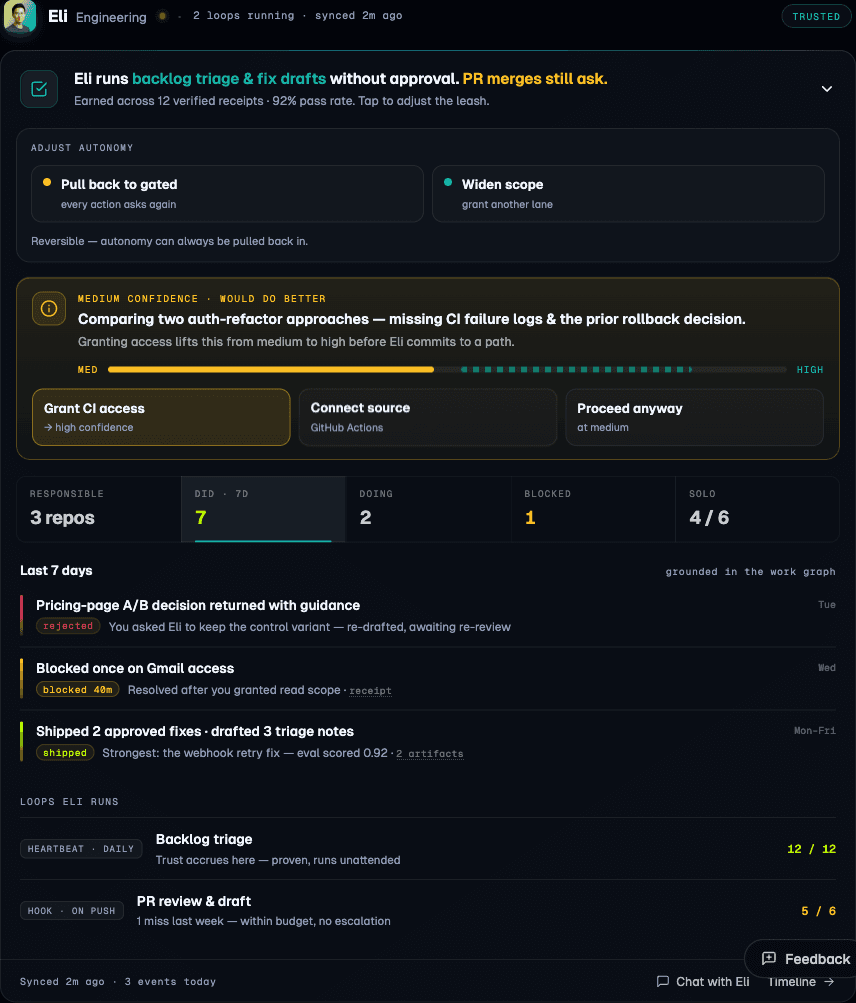
OrgX live desk showing an agent's focus, trust state, work, and recent outcomes
The operator's desk

The interface privileges current focus, the next consequential boundary, and grounded history over raw activity.

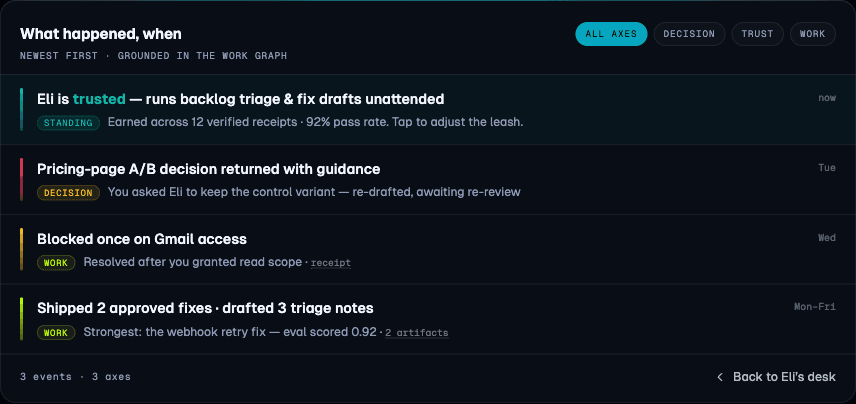
OrgX timeline showing decisions, trust events, and work outcomes
What happened, when

Decision, trust, and work events remain attributable in the same timeline instead of dissolving into logs.

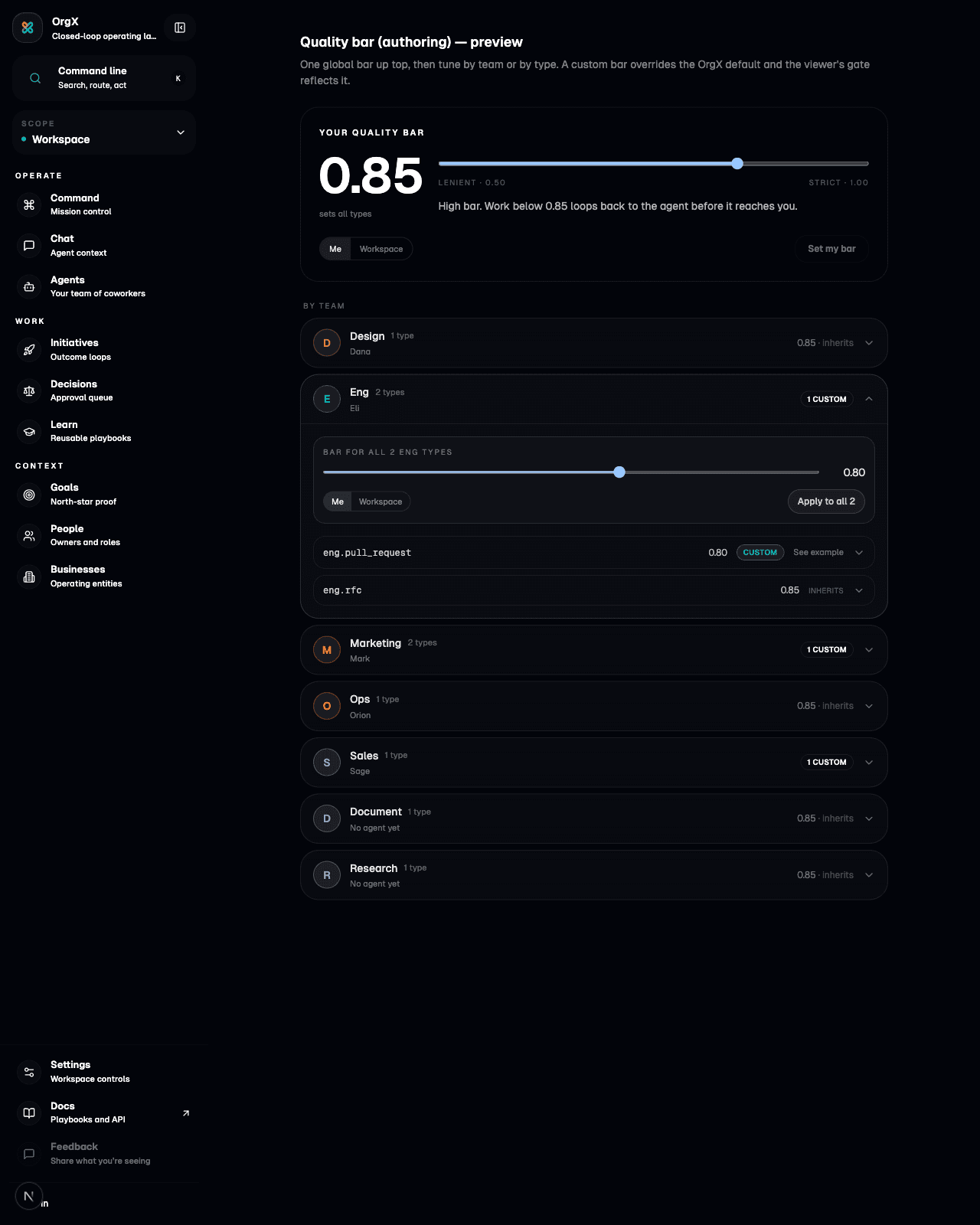
OrgX quality settings showing task-specific quality bars and model judges
A quality bar that can be inspected

The bar is explicit, versioned, and task-specific; observed signals stay visible without masquerading as the standard.

06

What changed in my operating model

The control surface is not a dashboard afterthought

The product is the quality of judgment the system makes possible.

OrgX changed my operating model from “automate the workflow” to “design the cause chain.” Every meaningful action should preserve context, expose its boundary, and return proof that improves the next decision.

Autonomy remains useful. Continuity is what makes it compound.

  • Escalate consequence, not mere activity.
  • Keep the score-bearing quality bar separate from runtime signals.
  • Treat the receipt as a first-class product surface.