01 / hostOpenClaw agents and gateway
Coding, research, marketing, and operations agents keep their existing tools, workspaces, and runtime lifecycle.
OpenClaw gateway · agent workspacesPersistent organizational memory and coordinated execution inside OpenClaw.
Every morning the lobster wakes up asking who it works for, until a bridge to OrgX carries the company in. Then the pixels resolve into the real screens: OpenClaw’s own control UI, the OrgX session, named agents, the activity record, Next Up kept apart from In Progress, and an outage where nothing is lost. Score: “Ravioli” by Hope Atina.
The OrgX bridge for OpenClaw. OpenClaw agents get the shared company context, coordinate work, and bring evidence back without leaving the host. It isn't OpenClaw itself, and it isn't another dashboard.
The consequential problem
OpenClaw could run agents and tools, but long-running organizational work needed more than a session. Tasks had to survive restarts, handoffs, and changing operators without becoming a pile of local state and logs.
Asking people to leave the host for a separate orchestration product would have added adoption friction at exactly the wrong boundary.
What I saw
The right architecture inherits OpenClaw's environment and lifecycle, then adds OrgX where the host is intentionally thin: shared context, resumable coordination, trust state, decisions, and receipts.
That makes the integration feel native while keeping the organizational model portable across the rest of the OrgX client ecosystem.
The decision that changed the system
The plugin coordinates through an MCP bridge, persistent queue state, and a live surface. Streaming keeps the interface current; durable records keep it honest when the stream disconnects, the host restarts, or work resumes later.
The initiative, constraints, and prior decisions enter OpenClaw together.
OpenClaw agents act through the plugin's coordinated tool surface.
Queue state and decisions survive the live connection.
Outcomes return to the shared work graph with provenance.
System anatomy / rationale / surfaces
The plugin has to respect two truths at once: OpenClaw owns the agent runtime, while OrgX owns the shared organizational context. The bridge is designed so either side can restart without making live transport the source of truth.
Moving an OpenClaw operator into a second orchestration destination would fracture the workflow the plugin is meant to improve.
Let OpenClaw own the runtime and tools while OrgX adds the missing organizational context through one native plugin seam.
Agents keep the host's strengths and gain shared goals, decisions, trust state, and receipts where they already work.
Coding, research, marketing, and operations agents keep their existing tools, workspaces, and runtime lifecycle.
OpenClaw gateway · agent workspacesA strict TypeScript ES module registers tools, services, dashboard routes, and background behavior through the host's single plugin entry point.
TypeScript · Node 18+ · native fetchThe local bridge at /orgx/mcp gives OpenClaw, Claude, Cursor, and Codex structured access without forcing a second cloud OAuth flow.
MCP tools · structured JSON · client config backupsSQLite stores run records, snapshots, and a local outbox. Queued events replay after sync; legacy JSON import and dead-letter records preserve a recovery path.
SQLite · JSON migration · outbox replaySSE is the primary live transport, with polling against the canonical snapshot as a fallback. Next Up intent stays separate from In Progress runtime state.
SSE · snapshot fallback · React hooksInitiatives, workstreams, milestones, tasks, decisions, activity, and receipts become shared context for every future agent and client.
OrgX API · entity graph · receipt modelNative fetch handles transport, while the SQLite store includes repair handling for missing native bindings.
Indexed run, snapshot, and outbox tables keep recovery state together while preserving a migration path for existing installations.
The interface can recover its operating picture without presenting the stream as durable truth.
Operators can distinguish scheduling, runtime state, blockers, and recovery instead of reading one ambiguous activity feed.
The system becomes tangible through the places people encounter and use it.
Browser pairing and manual key fallback establish the boundary without exposing credentials in the interface.
Initiative → workstream → milestone → task state makes the shared plan visible inside the host.
Pin, reorder, move, and bulk controls express scheduling before a run begins.
Live updates, decisions, completion, and failure stay attributable to named work.
Blocked and needs-review items become a focused operator queue rather than background noise.
Pause, resume, cancel, checkpoint, and rollback make long-running agent work recoverable.
TypeScript strict mode · ES modules · Node 18+ · native fetch
React 18 · Vite · Tailwind · Framer Motion
MCP · SSE · HTTP · snapshot polling
SQLite / better-sqlite3 · JSON migration · local outbox · automatic replay
node:test · Playwright · strict typecheck · end-to-end harness
Select a tool to see the role it plays in this system.
The host retains agent runtime, workspaces, tools, and lifecycle; the plugin adds the organizational layer instead of replacing it.
Authentic proof
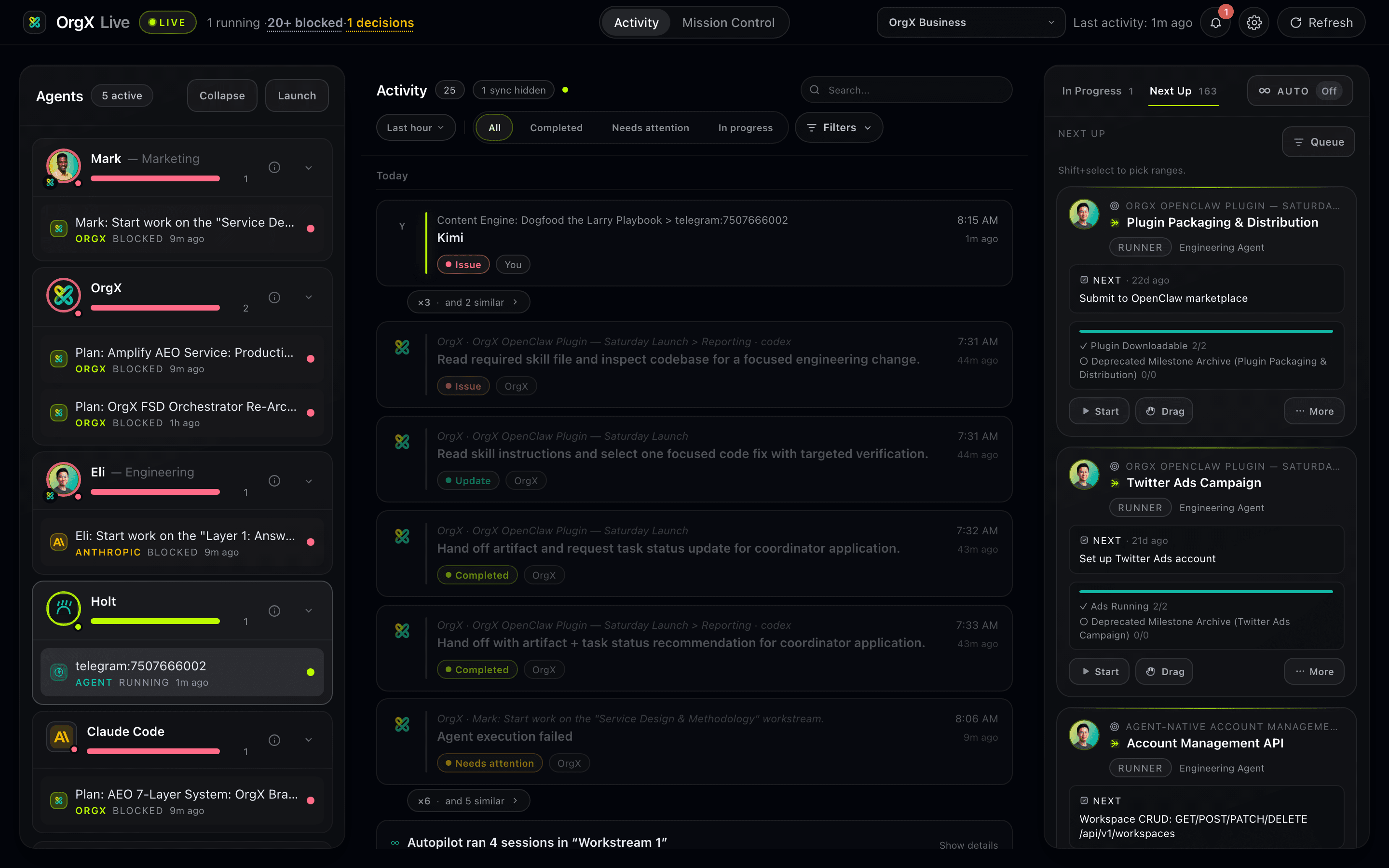
Named agents, current work, blocked decisions, activity, and next-up actions remain visible in one live control surface.
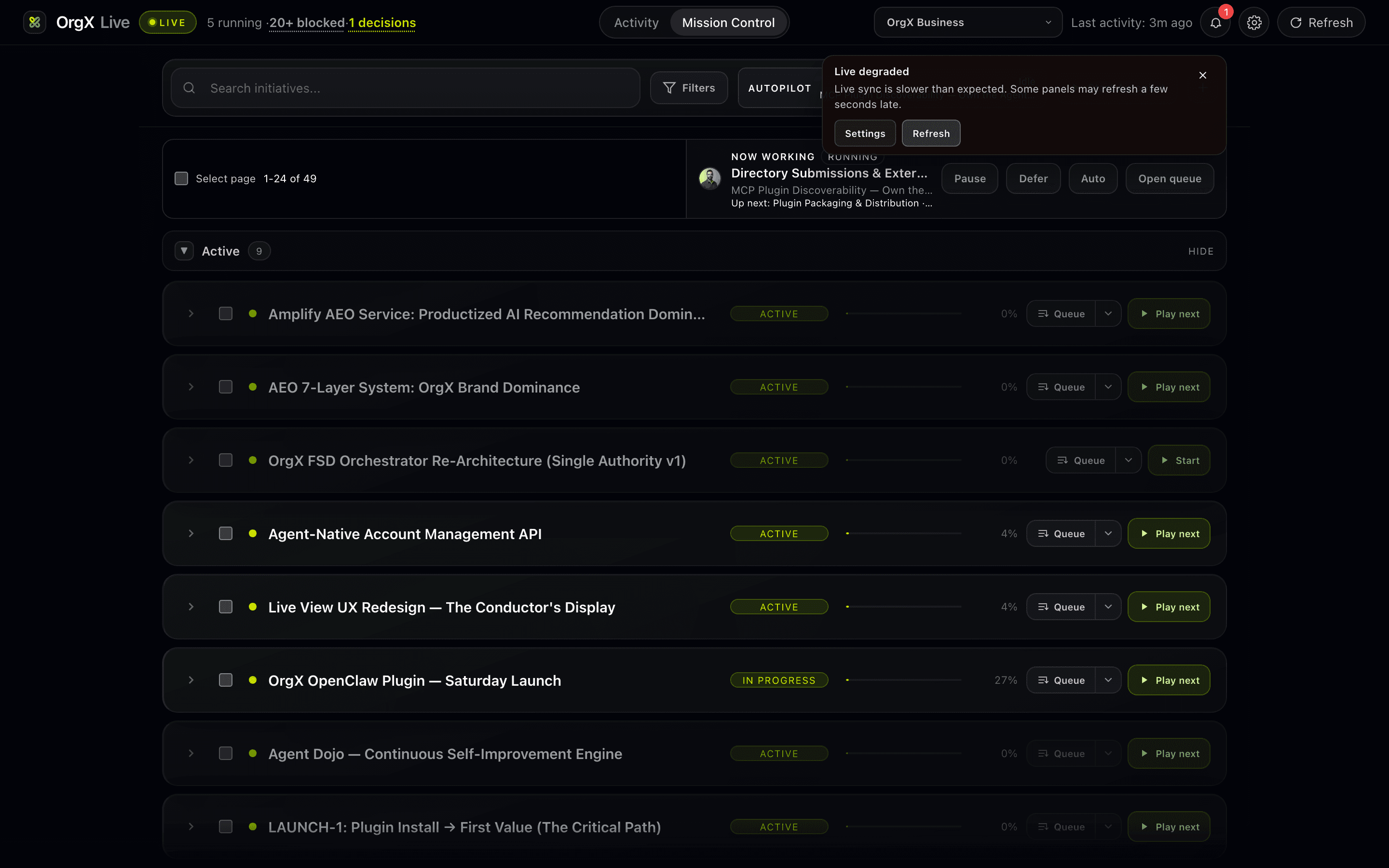
The next action remains explicit even when multiple workstreams are active or degraded.
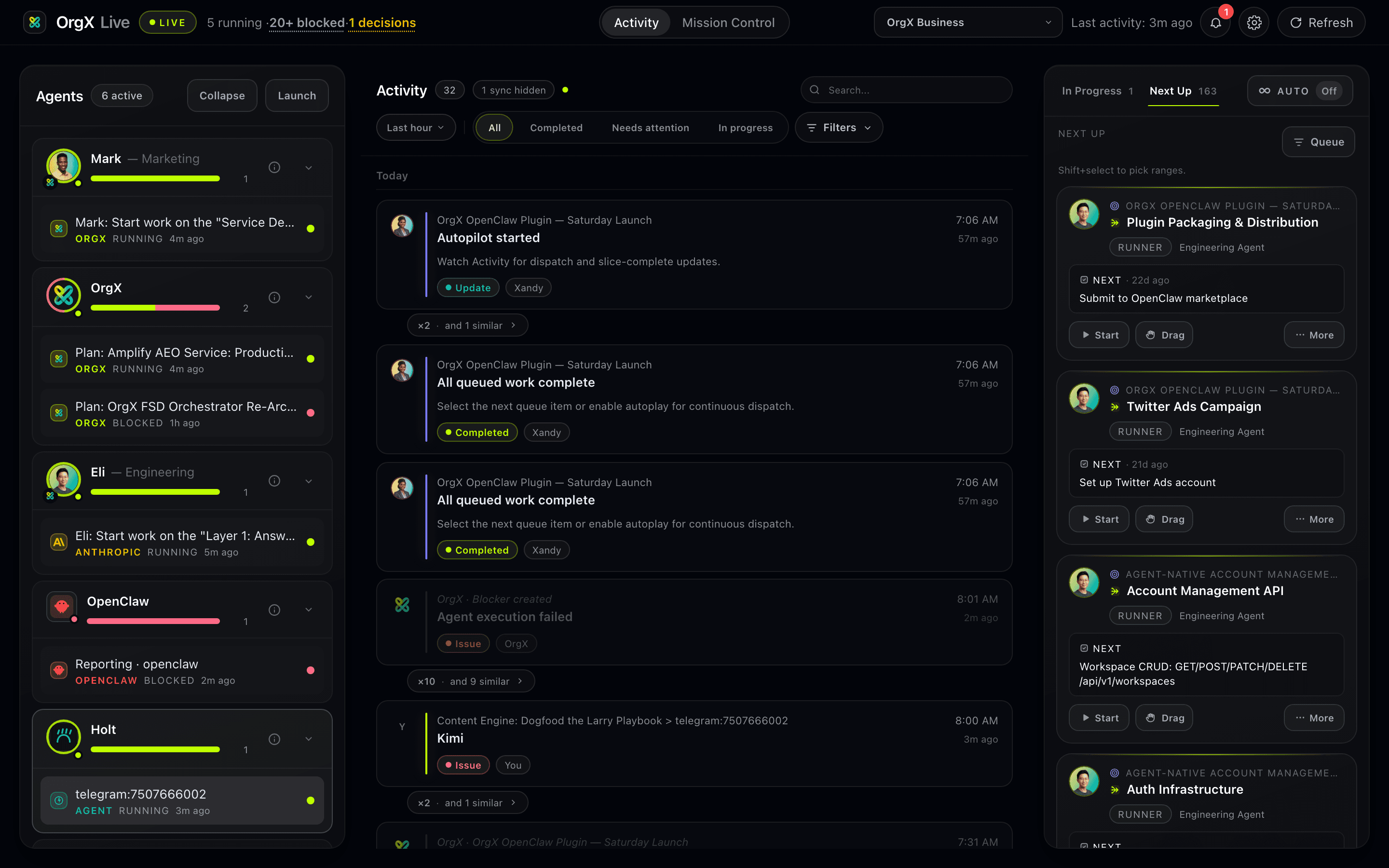
Completion, failure, and intervention remain attached to named work instead of collapsing into a terminal feed.
What changed in my operating model
OrgX for OpenClaw sharpened a rule I now use across the platform: preserve the host's strengths, add only the missing control layer, and keep durable truth independent from live transport.